By Thomas Wiewandt / May, 2021
Featured in the 2021 Winners Gallery of The International Color Awards
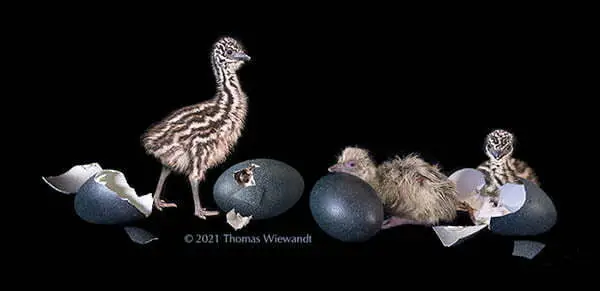
This panoramic photograph appears as a double-page spread (pp. 110-111) in FOSSILS INSIDE OUT. To help connect the past with the present, I needed an image of “The Miraculous Egg,” aka the amniotic egg, an evolutionary innovation that enabled reptiles and birds to successfully colonize land. Their eggs contain a complete life support system encased in a tough, drought-resistant shell. Even the mammalian placenta and its associated membranes are all derived from those in amniotic eggs.
Many if not most dinosaur eggs were no larger than emu or ostrich eggs, and surprisingly the largest eggs of any known animal, living or extinct, are those of a bird––Madagascar’s elephant bird, a 10-foot-tall giant driven to extinction by early human settlers. Through chemical analyses, scientists have been able to determine that the eggshells of a certain parrot-beaked dinosaur were blue-green, similar in color to those of today’s emu.
The closest living relatives of dinosaurs are birds, a realization that has grown from a proliferation of bird-like dinosaur remains discovered in recent years. To bring this connection to life, in May 2019 I decided to hunt for and photograph hatching emu eggs. I found a small neighborhood petting zoo in Arizona––Funny Foot Farm––with emus, capybaras, wallabies, and other unusual critters. The owners told me they incubate emu eggs, but the hatching season had just ended. Breeding would begin again in November. As advised, I checked back in December. Eggs were in the incubator, as hoped. Weeks later, during a power outage, the incubator failed, and the eggs never hatched.
Another batch was on its way, with a hatch expected in February 2020. I was put on high alert in March––one week went by, then another, and finally, the chicks began pipping in mid-March. Jeff Cravath, my intern, and I set up a photo platform with lights in a small feed shed on the farm and waited and waited some more. Finally, one bird broke free of its shell, and the next day another one. Jeff wrangled our cute models, individually, to keep them calm (no easy task). After two days of shooting until midnight, we had a few shots that looked good. We came home with a bag of broken eggshells to complete the shoot. The end result, shown here, is a composite that I created in Photoshop from nine separate images––to convey, with a little imagination, the beauty and magic of baby dinosaurs entering the world! -TW
Story behind Emu Egg Pictures in Fossils Book
You probably know that birds are now classified as reptiles, a realization that has grown from a proliferation of bird-like dinosaur remains discovered in recent years. And why were reptiles and birds so successful in colonizing land?––they have amniotic eggs, eggs with a complete life support system encased in a tough, drought-resistant shell. And while many dinosaurs laid hard-shelled eggs, some dino eggs were soft, like most modern lizards, snakes, and turtles. Through chemical analyses, scientists have even been able to determine that the eggshells of a certain parrot-beaked dinosaur were blue-green, similar to those of today’s emu. Emu eggs are the second largest eggs of any living bird, and native only to Australia. Many if not most dinosaur eggs were no larger than emu or ostrich eggs, and the largest eggs of any known animal, living or extinct, are those of Madagascar’s elephant bird, a 10-foot-tall giant driven to extinction by early human settlers. This is a tiny sample of the content in Fossils Inside Out.
Every photo in this book has an untold story behind it. In May 2019, I decided that we needed a photo of hatching emu eggs to illustrate the importance of the amniotic egg in the evolution of reptiles, birds, and mammals––yes, the mammalian placenta and its associated membranes are all derived from those in amniotic eggs. A friend of mine once raised emus here in Arizona, so I began searching for Arizona emu ranches on the Internet. Lo and behold, I found one listed here in Tucson less than 10 miles from my home, an unbelievable stroke of good luck! It’s a small petting zoo called Funny Foot Farm—they have emus, capybaras, wallabies, porcupines, and other unusual critters. So I contacted the owners––they do incubate emu eggs, but the hatching season had just ended. Breeding would begin again in November.
As advised, I checked back in December. Eggs were in the incubator, as hoped. Weeks later, during a power outage, the incubator failed, and the eggs never hatched. But another batch was on its way, with a hatch expected in February. I was put on high alert in March––one week went by, then another, and finally, the chicks began pipping in mid-March. Friend and colleague Jeff Cravath and I set up a photo platform with lights in a small feed shed on the farm and waited, and waited some more. Finally, one bird broke free of its shell, and the next day another one. Jeff wrangled our cute unruly models, individually, to keep them calm––no easy task. After two days of shooting until midnight, we had a few shots that looked good. We came home with a bag of broken eggshells to complete the shoot. The end result, a panoramic shown here, is a composite that I created in Photoshop from nine separate images––to convey, with a little imagination, the beauty and magic of baby dinosaurs entering the world!